
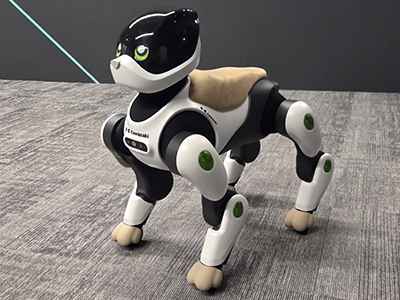
Kawasaki Heavy Industries has unveiled a dog-shaped robot that talks, fetches and alerts carers to falls.
Pup Robot Companion Puts Dignity and Data at Centre of Home Care Debate
Kawasaki Heavy Industries wants to put a robot dog in the homes of older people. Home Leo, a prototype shown to reporters in Tokyo, is meant to chat, keep an eye on its owner and tell family or carers if something looks wrong, with a launch pencilled in for fiscal 2028 in Japan.
What Home Leo Is Designed To Do
Kawasaki calls it a social robot driven by physical AI, meaning it is meant to converse, read the room around it, work out what the situation needs and then act without being told. At the Tokyo briefing, company president Yasuhiko Hashimoto asked the robot dog where he had put his phone. Home Leo told him the phone was on the table, walked over and brought it to him. Hardly dramatic, yet it showed speech, vision and physical handling working together in an ordinary domestic scene rather than a lab.
The company says the robot will build a picture of each owner’s tastes in food, clothing and housing so its conversation feels personal. For commissioners the more interesting feature is the planned alerting. Home Leo is meant to flag a fall, a shift in someone’s health, or something like a fire hazard left unattended, and pass that on to relatives or care professionals. Kawasaki says it is developing the robot with Japan’s health and industry ministries, local governments, care facilities and AI firms. So far there is no price and no performance data in the public domain.
Where Companion Robots Fit In UK Care Technology
Robot companions have a research record, though a patchy one. A scoping review of robots and computer agents aimed at loneliness found that most studies reported improvement on at least one loneliness measure, but it also logged downsides, including sadness when the robot was taken away. A randomised trial of the Paro robot in a rest home reported significantly lower loneliness than a control group. Most of that work involved simple, passive devices brought out for sessions. Home Leo is meant to live in the house, talk back and act on its own, which makes it closer to a lodger than an activity. A UK and Japan study of language-model companion robots, published this year, combined focus groups with placements in people’s homes, which says a good deal about how early the evidence is for that model.
For domiciliary providers the practical question is where a robot dog sits in a care package, rather than whether someone will take to it. The wellbeing principle in the Care Act 2014 takes in dignity, control over day-to-day life and personal relationships. A device that stands in for those will struggle at assessment. One that props them up has a better chance.
Workforce Pressure And The Case For Remote Monitoring
Skills for Care reports an adult social care vacancy rate of 6.2% in England for 2025/26, the lowest in a decade, though still roughly three times the rate across the wider economy. It expects the sector to need another 410,000 posts by 2040. Those figures underpin the commercial case for anything that watches over people between visits. Health services are already moving that way, with NHS virtual wards shifting acute recovery into people’s homes on a growing scale. A virtual ward comes with clinical oversight, though. A companion robot in a front room does not, and nobody has settled who picks up the call when it raises the alarm.
The Data And Safety Questions Providers Must Answer
A robot that spots falls is also a camera, a microphone and a running log of someone’s habits, tastes and health. A provider using one would be a data controller under UK GDPR. Alerts that drift towards clinical judgement bring in clinical safety duties under DCB0129 and DCB0160, and might attract MHRA attention. The CQC will want to know how consent works for people who lack capacity, and a person living with dementia cannot sensibly sign up to round-the-clock data capture the way a brochure assumes.
Dementia care is already testing that line. A Sussex care home has started using virtual reality headsets in its dementia unit, and the question hanging over that trial, whether the kit does anything for residents beyond signalling good intentions, applies just as well to a robot dog, with more at stake. Caroline Green of the University of Oxford has warned that AI in care can amplify bias and should support human contact rather than replace it. She has also pointed to the lack of a government policy aimed specifically at AI in social care.
What Comes Next For Social Care Innovation
Kawasaki has said nothing about the UK, and Home Leo may never arrive here in its current form. What matters is the direction of travel. Andy Burnham has put social care reform back on the political agenda, and what that settlement means for care technology investment will decide which tools providers can actually afford. The open questions are practical ones: who pays, who is liable when an alert goes unanswered, what evidence a commissioner will accept, and whether a product shaped around Japanese care translates to English home care.
Care technology has spent years promising carers more time. A robot dog promises company, which is a bolder claim and a riskier one. Until someone shows it adds to human contact rather than quietly replacing it, expect commissioners to stay unconvinced.

