
Tameside & Glossop Integrated Care NHS Foundation Trust has built its own AI tool to flag which A&E patients are most likely to come back within a month, then routes them into community follow-up before a crisis develops.
Greater Manchester Trust Deploys AI To Predict Who Returns To A&E
Emergency departments across England are used to being asked to do more with less. What is less common is a trust building the tool meant to ease that pressure in-house, rather than buying it off the shelf from a vendor with a slide deck full of promises. Tameside & Glossop Integrated Care NHS Foundation Trust has done exactly that, deploying an AI model developed by its own Business Intelligence team to identify which patients attending Tameside General Hospital’s A&E are likely to be back within 30 days.
If a hospital can spot the patients most likely to reattend before they walk back through the doors, it can intervene earlier, in the community, at lower cost and with less disruption to the patient. That is the theory behind a growing number of predictive tools now appearing across the NHS. Tameside’s version is notable for having been built internally rather than procured, and for the scale of improvement it claims.
A Model Built From Data Hospitals Already Hold
The system does not require new data collection. It draws on information already gathered during a routine A&E visit: how the patient arrived, their triage category, any long-term health conditions, and their history of emergency or inpatient attendances. From this, the model generates an individual risk score estimating the likelihood of reattendance within the following month.
That distinction matters. Much of the analytics used in acute trusts to date has been retrospective, telling managers what happened last month rather than what is likely to happen next. Liam Brierley, the trust’s Operational Intelligence Lead, framed the shift explicitly, saying the tool allows the trust to predict reattendance rather than simply reviewing it after the fact, moving from reactive care towards what he called intelligent, preventative intervention.
From Risk Score To Community Action
A risk score alone changes nothing. The trust says patients flagged as high risk are discussed by multidisciplinary teams drawing on both NHS staff and health and social care partners, who then coordinate tailored follow-up support intended to head off deterioration before it results in another emergency visit. The AI system continues monitoring those patients afterwards, checking that agreed actions have actually been carried out.
This is where the project touches directly on long-standing sector pressures. Integrated Care Boards have spent several years trying to strengthen exactly this kind of joined-up working between acute trusts, community health services and social care, often constrained by incompatible IT systems and tight budgets. The trust says the tool has been built as a single platform accessible from multiple devices, a deliberate attempt to avoid staff having to move between disconnected systems to make decisions.
Encouraging Early Numbers, With Caveats
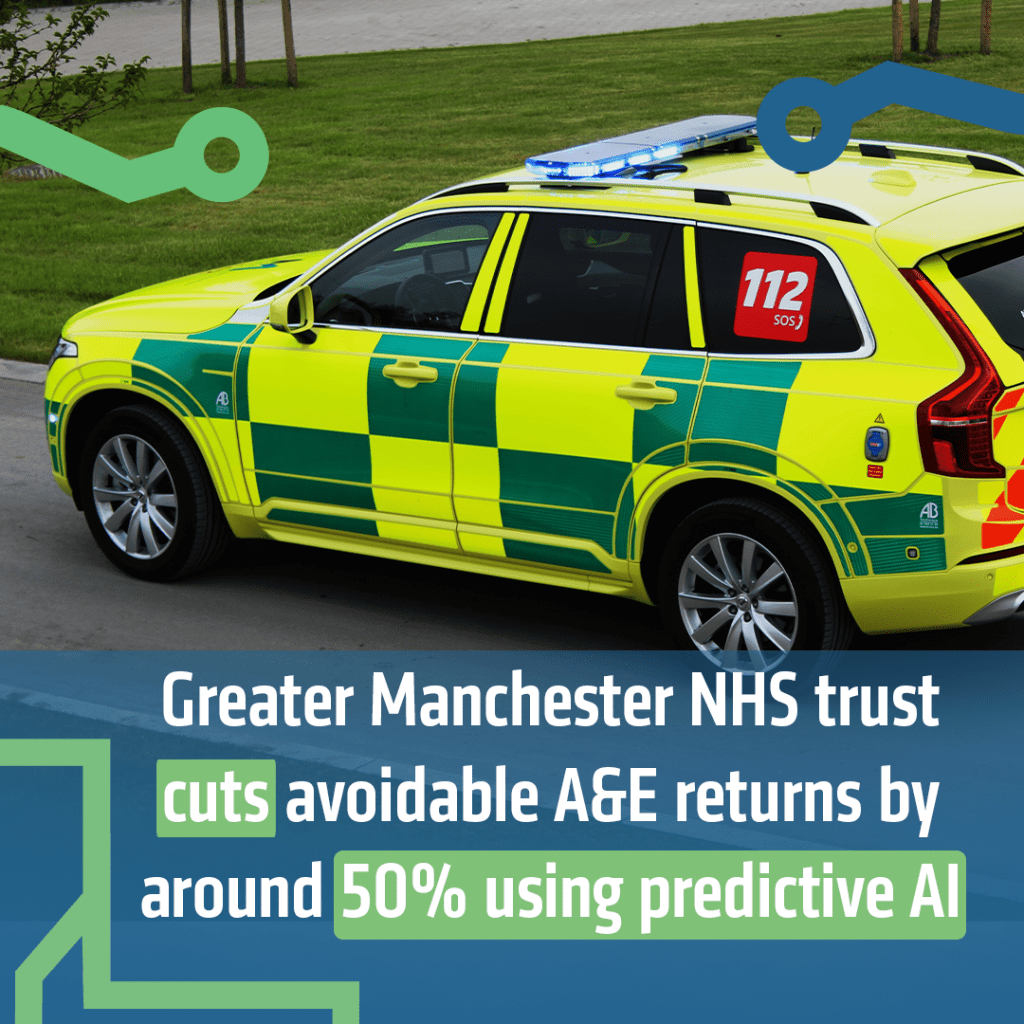
The trust reports that reattendance among patients flagged as high risk has fallen by between 33 and 50 per cent, though it is candid that the effect varies from week to week. Those are striking figures, and if they hold up under closer scrutiny they would represent a genuinely significant contribution to reducing avoidable A&E pressure.
At this stage, though, the evidence is entirely the trust’s own. There is no independent evaluation, published methodology, or peer-reviewed data behind the numbers, and the wide range quoted, itself, signals a system still bedding in rather than one with settled, reproducible results. Predictive risk-stratification tools in health and social care have a mixed evidence history; some studies have found genuine reductions in avoidable admissions, while others have found limited or inconsistent effects once compared against matched control groups. Commissioners and other trusts weighing whether to replicate this approach will want to see that scrutiny applied here too, alongside clarity on how the model performs across different patient groups and how algorithmic bias is monitored.
Part Of A Wider Shift Towards Predictive Care
Tameside’s tool sits within a broader move across the NHS towards prediction rather than retrospective analysis, echoing the logic behind virtual wards and other admission-avoidance schemes now operating in systems from Sussex to South London. The common thread is an attempt to intervene earlier in a patient’s deterioration, in the community, before hospital becomes the only option.
The trust says the model will continue learning as more data accumulates, with further automation planned to reduce administrative burden on clinical staff. Patient safety specialists were involved in designing the clinical processes around the tool’s use, and data security experts have overseen access controls, the trust said, though it has not published details of that governance framework.
The project’s profile has already grown well beyond Tameside. It has been shortlisted in the Urgent and Emergency Care Safety Initiative of the Year category at the 2026 HSJ Patient Safety Awards, with winners due to be announced on 28 September.
Whether other trusts follow depends less on the headline percentages than on what independent scrutiny eventually shows about consistency, fairness and cost. Built in-house and shortlisted nationally, this is a tool other systems will be watching closely, and one that deserves an evidence base to match the ambition behind it.


One thought on “Greater Manchester Hospital’s AI Tool Cuts A&E Reattendance By Up To Half”