
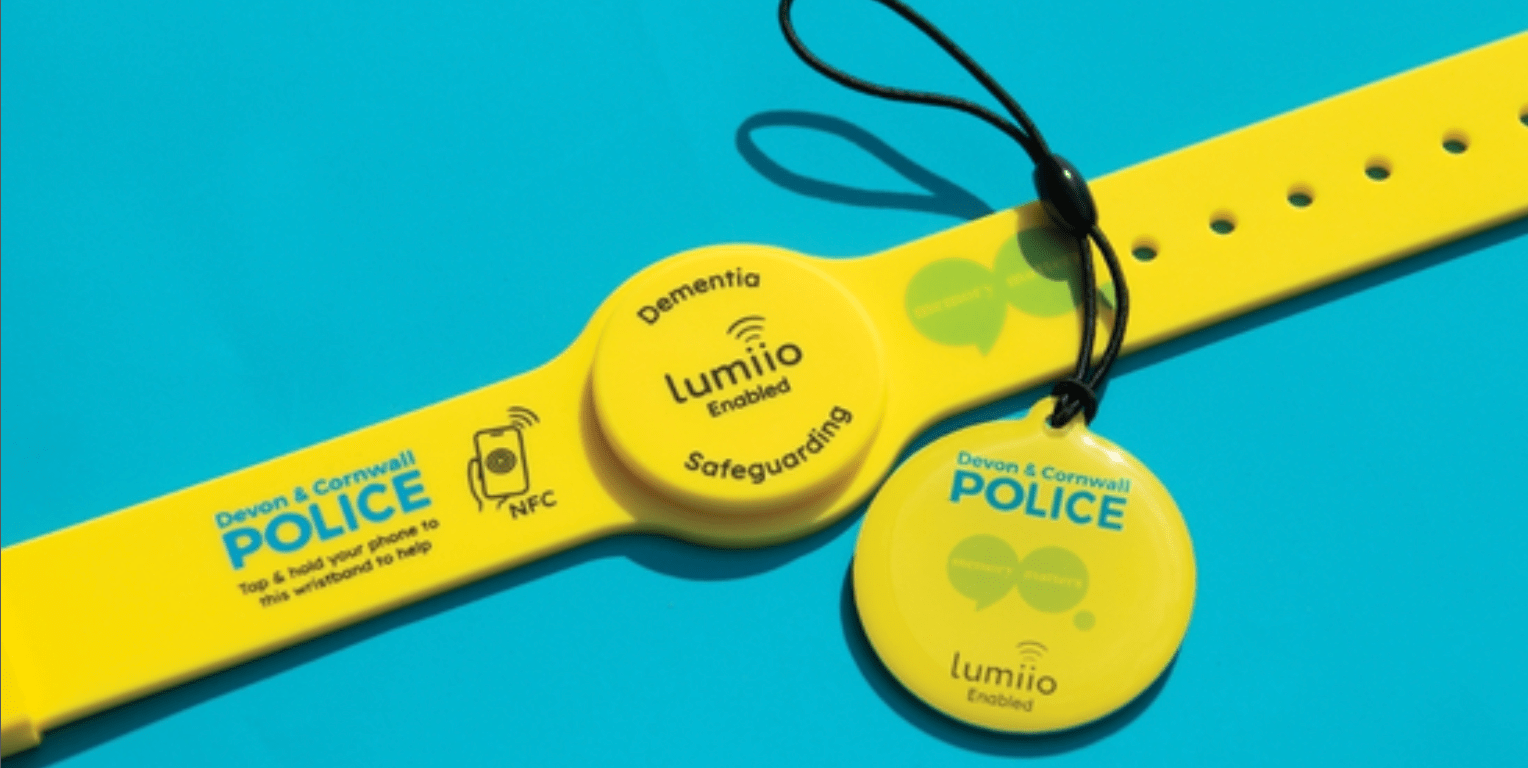
A trial underway in Plymouth is putting contactless wristbands and real-time GPS tiles into the hands of people living with dementia, and into the pockets of the police officers and family members trying to keep them safe.
When Someone With Dementia Goes Missing, Every Minute Counts
Dementia affects around 900,000 people in the United Kingdom today, and one of its most distressing and dangerous consequences is wandering. More than 40,000 people with dementia go missing across the UK in a given year, some found within hours, others not found safely at all.
Each incident stretches emergency services, devastates families, and risks serious harm to an individual who may have no means of explaining who they are or where they live.
It is a problem that has long resisted easy answers. Traditional approaches, identity bracelets, carer supervision, door alarms address the issue at the edges but do little to support people once they are already out in the community and beyond immediate reach.
Devon and Cornwall Police, in collaboration with Plymouth-based charity Memory Matters, are trialling a suite of wearable and tracking devices specifically designed to help locate missing people with dementia and reconnect them with family or emergency services as quickly as possible.
What The Devices Are And How They Function
The first category of device being tested is an NFC-enabled wristband or clip-on tag. NFC stands for near-field communication, a short-range wireless technology that allows two devices in close proximity to exchange small amounts of data instantaneously. It is the same underlying technology that enables contactless card payments and mobile pay systems, and it is now embedded in virtually every modern smartphone. In the context of this trial, the wristband or tag contains a small chip that stores a limited but vital set of information. The wearer’s name and a contact number for their next of kin.
If a member of the public encounters someone who appears confused or distressed, they do not need a specialist application or any prior knowledge of the scheme. They simply hold their smartphone near the device in the same way they might tap to pay at a supermarket checkout and the information appears on their screen immediately. The person can then contact the individual’s family directly or pass the details to the police. Only the person originally setting up the device on behalf of the wearer needs to download a dedicated app to configure it.
The second type of device being trialled is a Bluetooth and GPS tracking tile. These compact units small enough to be worn discreetly or attached to clothing or a bag broadcast their location continuously using a combination of GPS satellite positioning and Bluetooth signals. GPS provides broad geographic location data, accurate to within a few metres outdoors, while Bluetooth can assist with more granular positioning in areas where satellite signals are weaker, such as shopping centres or public transport. Police officers and authorised family members can monitor the tile’s location in real time through a connected application, enabling a far faster response when someone is reported missing.
Giving People The Confidence To Keep Living
Dementia is a condition that progressively strips people of autonomy and that process is often accelerated not by the disease itself but by risk-averse decisions made by families and services trying to keep people safe. People are asked to stay home. Outings become supervised events.
Successive government strategies on dementia have emphasised the importance of enabling people to live well in their communities, and the Care Act 2014 places a statutory duty on local authorities to promote individual wellbeing, including the person’s contribution to society and their sense of control over their own lives. Technology that supports safe community participation is not merely convenient in policy terms, it is aligned with the legal and ethical framework governing adult social care.
Privacy, Consent, And The Ethics Of Location Monitoring
Any discussion of tracking technology in care must engage seriously with questions of privacy and consent. The Plymouth trial stores only minimal data, a name and a next-of-kin contact number and does not involve continuous surveillance or centralised data retention in ways that might raise concerns under UK data protection law. This approach reflects the principle of data minimisation that sits at the heart of UK GDPR, collecting only what is necessary, and no more.
There is, nonetheless, a broader ethical conversation to be had about the use of location tracking with individuals who may lack the capacity to give fully informed consent. Best practice guidance from organisations including the Social Care Institute for Excellence emphasises that technology interventions involving monitoring should be subject to careful best-interests assessment, involve family members and advocates, and be reviewed regularly. Care providers and commissioners adopting similar tools at scale will need to embed these safeguards into their processes, not treat them as an afterthought.
What Comes Next For Community Dementia Technology
The Plymouth trial is still gathering evidence, and formal outcomes data is some way off. But the direction of travel is clear. As the UK population ages and dementia prevalence rises the Alzheimer’s Society projects the number of people living with dementia in the UK will exceed 1.6 million by 2040 the pressure on care services will intensify. Low-cost, community-deployable technology that extends safety without restricting independence will become an increasingly important part of the response.
The bright yellow wristbands being worn on the streets of Plymouth are, in one sense, a small intervention. In another, they represent something worth watching closely, a template for how care technology can work quietly in the background, giving people the freedom to live their lives while ensuring that, if something goes wrong, help is never more than a tap away.

