
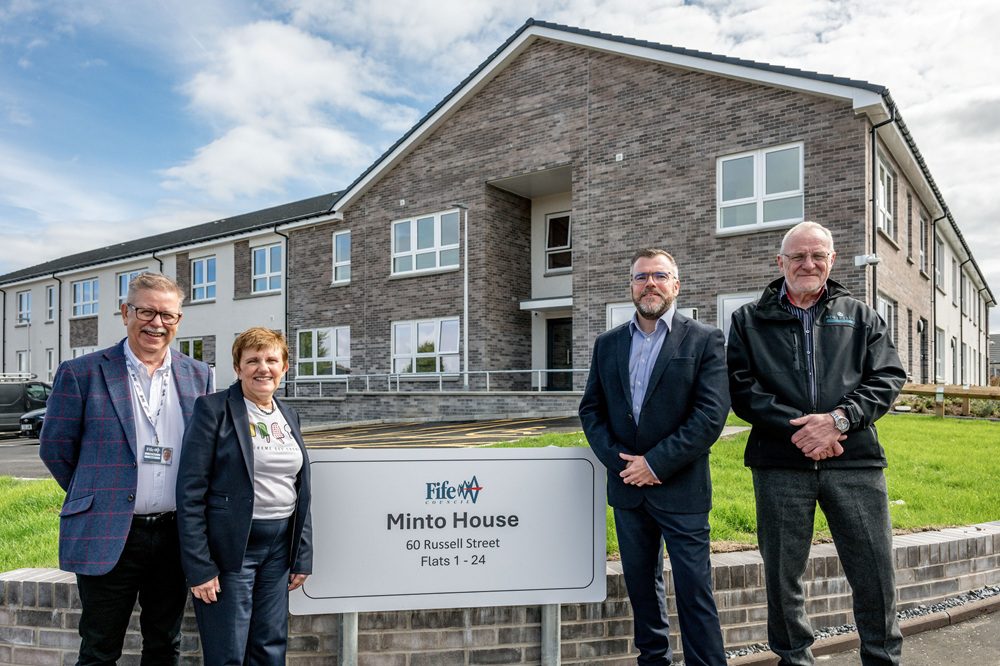
Forty-four affordable homes, including a 24-flat extra care facility, have opened on a site in Lochgelly that stood empty for seven years. The completion closes out the latest phase of Fife Council’s Affordable Housing Programme and lands directly in the middle of a national argument about whether Scotland is building extra care housing fast enough to meet demand.
Lochgelly Scheme Tests Scotland’s Bet On Keeping Older People At Home
A patch of ground in Lochgelly that had sat derelict since a former care home was demolished seven years ago is now home to 44 new properties, among them a 24-flat extra care facility that Fife Council will operate directly. The development, delivered by Robertson Partnership Homes, is a small scheme by national standards. Its significance lies less in scale than in what it represents: a local authority betting capital on a housing model that policymakers across the UK keep endorsing in principle and struggling to deliver in practice.
From A Demolished Care Home To 44 New Homes
The Lochgelly site combines 20 amenity homes, a mix of bungalows for people who need step-free living but not on-site support, with the extra care block itself. That facility comprises ten one-bedroom amenity flats, ten two-bedroom wheelchair-accessible flats and four two-bedroom amenity flats, designed for residents aged 55 and over with varying care needs. Every property meets the Scottish Government’s Housing for Varying Needs standards, and the scheme has been built against Silver Standard sustainability criteria, with solar panels, A-rated boilers and high-performance insulation intended to deliver an EPC rating of B. The bungalows include wet-floor showers as standard; the wheelchair-accessible flats have adjustable kitchen worktops.
This is the seventh and final project in the current phase of Fife Council’s Affordable Housing Programme delivered through Robertson, taking the total completed in that phase to 320 homes. For a council managing housing waiting lists alongside adult social care demand, closing out a multi-site programme on a previously unusable brownfield plot is a genuine delivery win, whatever else is said about the wider system around it.
Extra Care As An Alternative, Not An Afterthought
What makes the Lochgelly scheme worth attention beyond Fife is the model itself. Extra care housing sits deliberately between independent living and residential care: self-contained tenancies with on-site staffing available as needs change, built around Scotland’s long-standing Reshaping Care for Older People agenda, which has pushed local authorities to shift spend away from institutional settings and towards housing that lets people remain part of a community for longer. Councillor Judy Hamilton, Fife Council’s spokesperson for housing and building services, framed the completion in exactly those terms, saying the facility would help more people stay part of their local community while receiving the care and support they need.
That framing matters for commissioners well beyond Fife. Scotland’s extra care stock has consistently lagged behind demand projections, and the sector body ARCO has flagged the country as trailing other parts of the UK on housing-with-care provision relative to its ageing population. Every scheme that reaches completion is a small correction to that gap, but the pace of delivery nationally remains the open question the sector keeps returning to.
The Workforce And Supply Chain Dividend
Robertson has also used the project to make a case for how capital housing spend can double as workforce investment. The company reports 361 apprenticeship weeks generated across the scheme, six CSCS cards funded for Fife College students, eleven weeks of work experience placements and taster sessions run at Lochgelly High School through its Ideal Candidate Programme. Susan Wilson, commercial director at Robertson Construction Eastern, pointed to the wider pattern across the 320-home phase as evidence that affordable housing delivery can be built around local supply chains and SME spend rather than displacing them.
For an ICS or local authority audience watching every capital pound scrutinised, that dual return, homes delivered and a construction workforce pipeline seeded locally, is the kind of detail that tends to feature heavily in future business cases.
Whether Delivery Can Match The Rhetoric
The harder test starts now. A completed scheme still needs to be staffed, and Scotland’s social care workforce pressures are as acute as anywhere in the UK, a point Andy Burnham’s recent social care warnings have kept firmly on the agenda south of the border and one that applies with equal force north of it. Extra care housing only delivers on its promise, keeping people out of residential care and hospital beds, if the on-site care model is properly resourced and sustained. Fife Council will be watched closely on that point, as will every local authority weighing whether extra care housing is a genuine alternative to institutional care or simply a more attractive way of describing the same capacity shortfall.
Lochgelly is one small, well-built answer to a much larger question. Whether Scotland can replicate it at the pace its ageing population requires is a story this publication will keep returning to.


One thought on “Fife Council Opens 24-Flat Extra Care Facility On Long-Vacant Lochgelly Site”