
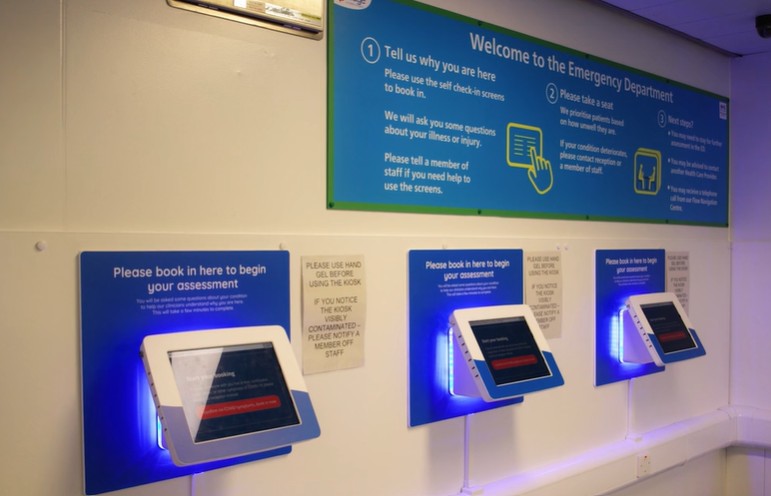
NHS Greater Glasgow and Clyde has launched a digital triage system in its accident and emergency departments, giving clinicians structured patient data within minutes of arrival.
Digital Kiosks In NHS Greater Glasgow A&Es Aim To Prioritise The Sickest Patients Faster
NHS Greater Glasgow and Clyde (NHSGGC ) is rolling out a digital triage system across its accident and emergency departments, a development that signals a broader shift in how Scottish health boards are attempting to manage demand at their most pressured front doors.
The system, known as eTriage, launched first at the Queen Elizabeth University Hospital in June 2026, with the Royal Alexandra Hospital, Glasgow Royal Infirmary, and Inverclyde Royal Hospital scheduled to follow. On arrival, patients check in via a digital kiosk and complete a short series of clinically designed symptom questions on a touchscreen. Their responses are transmitted immediately to the clinical team, meaning staff have structured patient information before that individual has even reached the waiting area.
That seemingly small operational shift carries real clinical weight.
A Faster Picture At The Front Door
In a busy emergency department, the difference between a four-minute triage assessment and a fifteen-minute one is not administrative, it is clinical. Patients deteriorate in waiting rooms. NICE has long recognised that delays in emergency triage are associated with worse patient outcomes, and Scotland’s A&E performance data has reflected endemic pressure across major units for several years.
What eTriage does is compress the information-gathering phase. By the time a clinician formally assesses a patient, they are working from structured symptom data rather than starting cold. That has implications for both speed and consistency: the questions asked are standardised, removing variability in how presenting symptoms might be interpreted during a busy shift.
The system also offers a privacy benefit that is easy to underestimate. In a crowded emergency department, patients currently state their symptoms audibly at a reception desk. For presentations involving mental health, sexual health, or domestic violence, that is a significant barrier to honest disclosure. A kiosk removes it.
Part Of A Larger Virtual Hospital Strategy
NHSGGC has been explicit that eTriage is not a standalone tool. It forms part of the board’s Virtual Hospital programme, an initiative designed to expand the range of settings in which patients can safely receive care and reduce unnecessary footfall in physical hospital environments.
The longer-term ambition is for information gathered at the kiosk to be reviewed by clinical teams sitting outside the emergency department, including those working within the Virtual Hospital. If a patient presents with a condition that does not require emergency assessment, they could be redirected before spending hours in a waiting room: offered a virtual consultation, a booked appointment at a community service, or clinical advice that resolves their need without hospital attendance.
That is the model. Its realisation depends on the Virtual Hospital having sufficient clinical capacity and the right pathways to absorb redirected demand. Neither can be assumed. Diversion systems that are well-designed in theory have historically struggled when the alternative services they point patients towards are themselves under pressure.
The Workforce Question
NHSGGC has been careful to frame eTriage as an addition to existing staffing rather than a replacement for it. Front-of-door reception staff remain in post. The kiosk is for patients who are comfortable using it, with a traditional desk still available for those requiring additional support due to accessibility requirements, language barriers, or low digital confidence.
That framing matters politically as much as practically. Digital check-in systems in healthcare have faced resistance when they appear to substitute for human contact in settings where vulnerable people are already anxious. The argument that the system generates real-time waiting room visibility enabling clinical staff to monitor patients continuously rather than relying on periodic observation addresses safety as much as efficiency.
What The Sector Should Watch
The question for other health boards and integrated care systems weighing similar investments is not whether digital triage is a good idea. The evidence base for structured, technology-assisted triage is reasonably established. The question is whether the back-end pathways are in place to make redirection safe and clinically defensible.
For that to work at scale, the Virtual Hospital needs to be more than a brand. It needs clinical capacity, clear protocols, and real-time coordination with community services and the ability to confirm, at any given moment, that the alternative it is directing a patient towards can actually see them.
Lorraine Cowie, Director of Interface for NHSGGC, said the system would help guide some patients to more appropriate services while allowing emergency departments to focus on the most serious conditions. The aspiration is coherent. Whether the infrastructure can match it is a question the next phase of the rollout across three additional sites will begin to answer.


2 thoughts on “Glasgow Health Board Rolls Out eTriage System To Speed Up Emergency Department Assessment”