

Every twenty minutes, someone in the UK is diagnosed with Parkinson’s disease, yet treatment progress has historically moved slowly, built on decades-old drugs and incremental surgical advances. That is now changing, with major UK-led trials and emerging technologies signalling a rapid shift in how the condition may be detected, monitored, and treated.
Here is an uncomfortable truth to end Parkinson’s Awareness Month with. Every twenty minutes, somebody in the UK is told they have Parkinson’s disease. Not every hour. Not every day. Every twenty minutes. And yet, as Parkinson’s UK’s latest prevalence data confirms, around 166,000 people are currently living with a confirmed diagnosis. With thousands more thought to be navigating symptoms entirely alone, undiagnosed, and without support.
For a condition this prevalent, this relentless in its progression, and this demanding on NHS and social care resources, the pace of technological change has until recently, felt frustratingly slow.
Levodopa, still the cornerstone of Parkinson’s drug treatment, has been around since the 1960s. Deep brain stimulation, the most significant surgical advance of the modern era, has been in use since the 1990s. Progress has happened, but it has happened quietly, in increments, largely invisible to the public.
Something has shifted. In the past year, the Parkinson’s treatment landscape has seen more genuine, substantive innovation than arguably the previous two decades combined. New devices are reaching patients. New trials are launching at a scale never previously attempted in the UK. And investment from government, from charities, from the private sector, is flowing in a way that actually warrants optimism rather than the performative kind that tends to accompany awareness months.
A £26 Million Bet on The World’s Largest Parkinson’s Trial In The UK


In October 2025, UCL and Newcastle University launched the world’s largest-ever clinical trial for Parkinson’s disease. The EJS ACT-PD trial has a £26 million budget and is recruiting up to 1,600 participants across more than 40 hospitals in England, Wales, Scotland and Northern Ireland.
What makes it genuinely different is the structure. Traditional drug trials test one treatment at a time, over years, burning through time and money on a process so slow that many patients never live to see results. EJS ACT-PD tests multiple drugs simultaneously, drops the ones that aren’t working, and accelerates the ones that are. The organisers estimate this design alone could cut up to three years from the standard assessment timeline. Sub-studies within the trial, funded by the Michael J. Fox Foundation, are also investigating whether wearable technologies can monitor symptoms digitally and identify molecular signatures of Parkinson’s in real time.
This is not just a research story. It is a signal that the UK is positioning itself as the country where the next generation of Parkinson’s treatments gets proven and that has real implications for NHS procurement, commissioning, and care planning further down the line.
The money backing that ambition is substantial. In March 2025, the UK Dementia Research Institute and Parkinson’s UK announced a joint £10 million research centre focused on understanding the causes of the disease and finding new treatments. Cure Parkinson’s currently has 33 active research projects with a combined funding commitment of £18.7 million, including a £2 million call specifically for combination therapies that might slow disease progression. The government’s June Spending Review committed up to £10 billion to expand technology use across the NHS.
Whether that money reaches Parkinson’s patients meaningfully, rather than disappearing into general digital infrastructure, is a question care sector advocates are watching closely.
The Helmet That Could Replace Brain Surgery
If you wanted a single image to capture how dramatically the treatment landscape is shifting, the ultrasound helmet developed by UCL and the University of Oxford would do it.
Deep brain stimulation, surgically implanting electrodes into specific brain structures and running wires to a pulse generator under the skin, has been transformative for many people with advanced Parkinson’s. It changes the electrical signals in the brain that cause movement symptoms, and can be turned on or off, though the level of stimulation itself doesn’t vary. It also involves opening a person’s skull. The risks are real, the recovery is significant, and not everyone is a suitable candidate.
The Oxford and UCL team have built a system that can achieve comparable precision without any of that. Using transcranial ultrasound stimulation, gentle mechanical pulses delivered through a wearable helmet, the device can precisely target deep brain structures that were previously impossible to reach non-invasively.
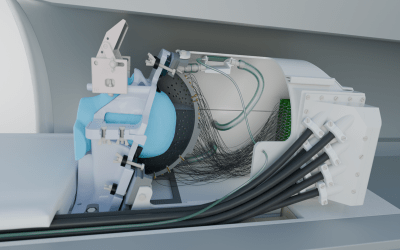
Dr Ioana Grigoras from Oxford’s Nuffield Department of Clinical Neurosciences, who co-led the research, was direct about its potential: the team is “particularly excited about its potential clinical applications for neurological disorders like Parkinson’s disease, where deep brain regions are especially affected.”
Several members of the research team have since founded NeuroHarmonics, a UCL spinout developing a portable, wearable version of the system, with the explicit aim of making this kind of precision brain therapy accessible well beyond the walls of a neurosurgery unit. The commercial journey from research prototype to clinical device is never straightforward, but the direction of travel here is unmistakable.
The DBS System That Listens
For patients who already have DBS implants, the more immediate revolution is happening inside the device itself. Traditional DBS is, by design, blunt, it delivers the same level of electrical stimulation continuously, regardless of what the patient is actually experiencing at any given moment.
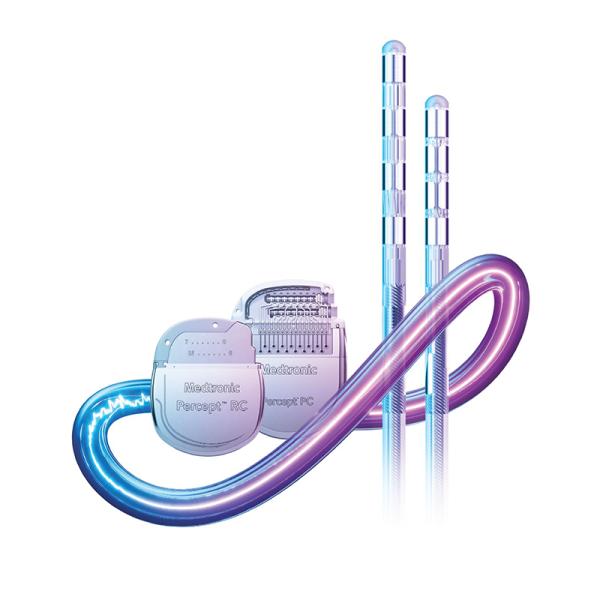
Adaptive deep brain stimulation changes that by turning the implant into a two-way system. Medtronic’s BrainSense aDBS technology reads the brain’s own electrical signals in real time and adjusts stimulation accordingly, automatically, continuously, without the patient needing to do anything. Kevin, a Parkinson’s patient from Sunderland, was among the first in the UK to have the system fitted. Previously, managing his DBS meant regular hospital visits to have the settings manually adjusted. With BrainSense aDBS, those visits have reduced significantly, the device responds to his needs without him having to travel to a clinic.
AI on Your Ankle and Wearable Devices
Away from the operating theatre, a quieter but arguably more immediately impactful technology shift is under way in wearable devices and it is moving fast.
A major scoping review published in the Journal of Medical Internet Research in February 2026 confirmed that AI-enabled wearable devices are rapidly emerging in both rehabilitation and motor function assessment for Parkinson’s, though it was also candid about the gap between what works in research settings and what is actually reaching clinical practice. That gap is real, and closing it should be a priority for NHS digital leads and commissioners.
A further sign that this space is accelerating came in April 2026, with reports of a £50 million investment into wearable tremor technologies aimed specifically at Parkinson’s care. The funding is being directed at scaling next-generation sensors and AI-driven monitoring systems that can track tremor patterns more continuously and accurately in everyday environments, rather than short clinical snapshots. The aim is to improve early detection of symptom changes, refine medication timing, and reduce the reliance on in-person assessments by strengthening remote clinical decision-making. It also reflects growing confidence from investors and healthcare stakeholders that wearable neurological monitoring is moving from experimental research into a commercially viable, clinically embedded layer of Parkinson’s care.
Among the devices already crossing that divide is STAT-ON, a waist-worn inertial sensor with onboard AI processing. It can accurately detect key motor symptoms, supporting clinicians in treatment decisions, including identifying patients who might benefit from advanced therapies such as DBS or continuous drug infusion pumps. A 2025 analysis in PLOS ONE made a case for its economic as well as clinical value noting that in Parkinson’s, the dominant cost driver is care needs rather than drugs or hospital visits, especially in the advanced stages. A device that helps clinicians intervene earlier and more precisely has the potential to bend that cost curve.
Then there is ParCuR, a compact ankle-worn device combining an inertial sensor, haptic stimulator, and AI software that detects freezing of gait episodes in real time and automatically delivers sensory cues to help patients resume walking. Freezing of gait, where a person with Parkinson’s suddenly finds their feet apparently glued to the floor, is one of the condition’s most frightening symptoms, and one of its most dangerous in terms of fall risk. Early users of ParCuR described it as discreet and reliable. One participant called it nearly an extension of the human body. That is exactly the kind of feedback that distinguishes a device people will actually wear from one that ends up in a drawer.
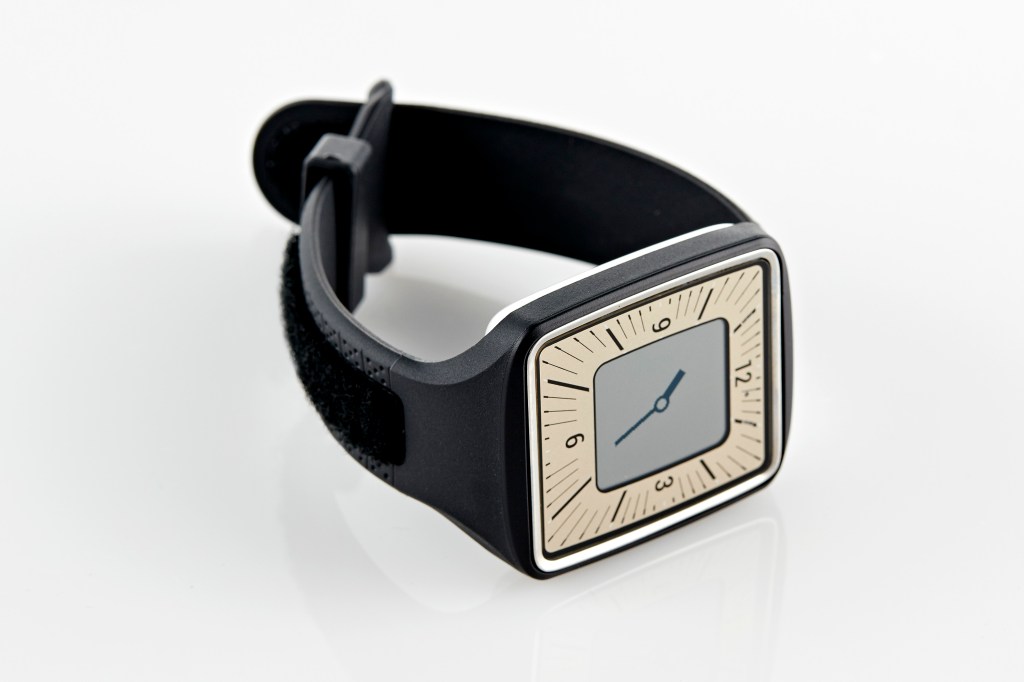
The Parkinson’s KinetiGraph (PKG), a wrist-worn device providing continuous tremor data over time, is already being used in UK hospital settings, helping clinicians make more informed medication decisions without requiring patients to come in for assessment. Research has confirmed the potential of such devices to enable remote monitoring and web-based clinics, reducing the burden on patients and carers, particularly those in areas with limited access to specialist services.
Beyond the Clinic Shoes, Speech, and Daily Life
Not every useful device is a medical instrument. A growing range of consumer-oriented assistive technologies is reaching people with Parkinson’s, and care providers and occupational therapists would do well to know they exist.
NUSHU smart shoes use real-time vibrotactile feedback to analyse gait and deliver instant corrective cues, with clinical teams able to monitor the data remotely. For someone whose shuffling walk puts them at daily risk of a fall, and for the family member or carer who worries about them when they’re moving around the house alone, that is a genuinely meaningful piece of kit.

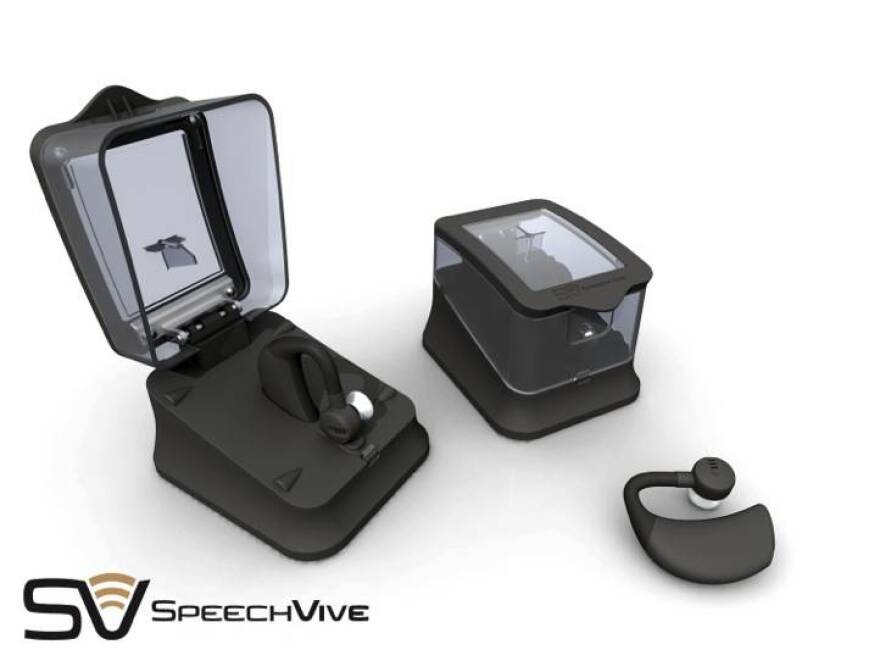
SpeechVive, a wearable speech device, automatically triggers the brain’s reflex to speak more loudly and clearly addressing the quiet, slurred speech that isolates many people with Parkinson’s from conversation and social connection. And platforms like NeuroRPM, running on Apple Watch, track the full motor symptom profile, tremor, bradykinesia, dyskinesia, feeding data to care providers for more personalised, responsive treatment planning.
Technology Can’t Fix a Diagnosis Crisis
It would be dishonest to write about Parkinson’s technology innovation without acknowledging the structural problem sitting beneath all of it. The tools are improving. The system delivering them is not keeping pace.
Around 28,000 people in the UK will receive a Parkinson’s diagnosis this year, someone new every twenty minutes and the evidence suggests many more are living with the condition undetected, largely because of long waiting times for neurology services and a shortage of specialists.Caroline Rassell, Chief Executive of Parkinson’s UK, put it plainly, she said, “We desperately need the NHS to address this diagnosis crisis, the growing backlog, and improve access to quality, specialist care.”
A non-surgical brain stimulation helmet is remarkable. An AI ankle device that prevents falls is genuinely life-changing. But none of it helps the person who hasn’t been diagnosed yet, or who lives three hours from the nearest Parkinson’s specialist nurse, or who simply cannot navigate a system that remains chronically under-resourced for neurological conditions.
The technology is ready to do more than the system is currently allowing it to. That is perhaps the most important thing to say this Parkinson’s Awareness Month, not just that innovation is happening, but that making it count requires the NHS, commissioners, and government to move with the same urgency the researchers clearly are.

