
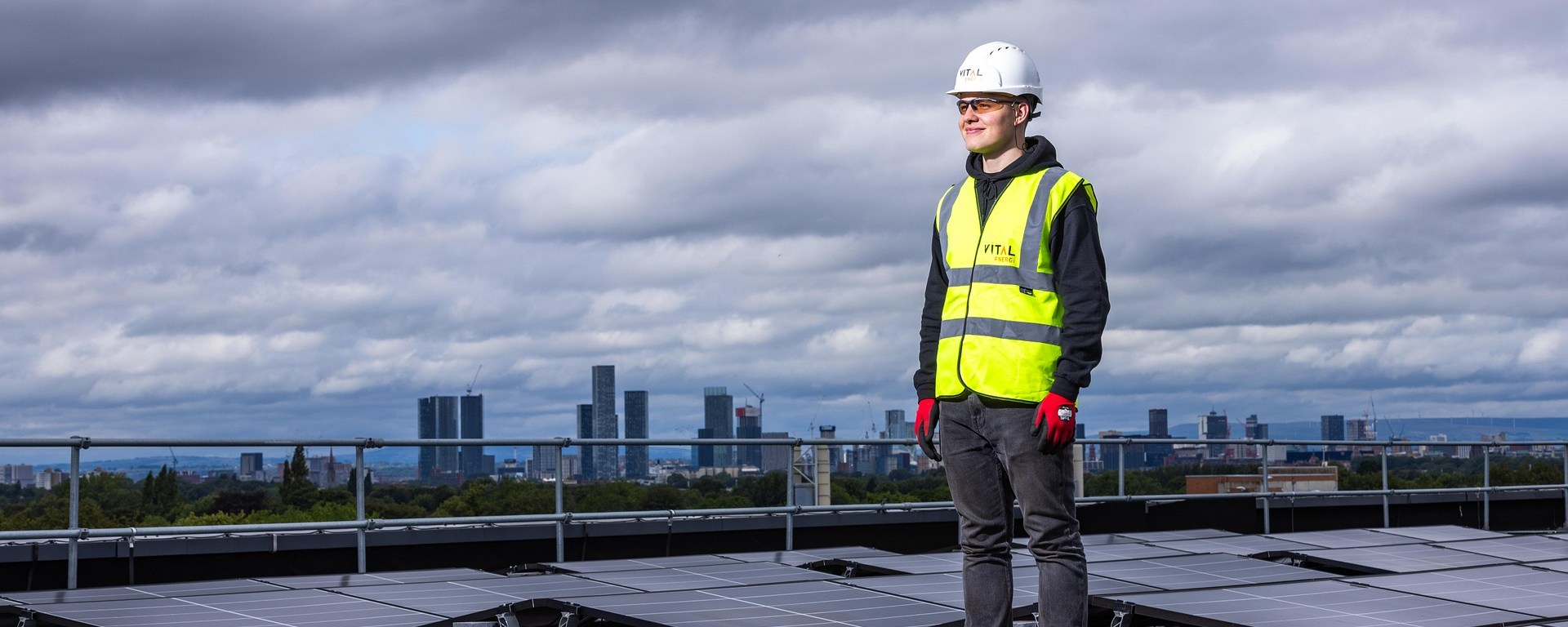
The government has unveiled its most ambitious clean energy package yet from plug-in solar panels hitting high street shelves within months, to solar and heat pumps becoming standard in new homes. For the care sector, the implications go well beyond energy bills.
What Does The UK Clean Energy Push Mean For Care at Home
The questionable Israeli war on the middle east has done what years of climate campaigning struggled to achieve.
It has forced the UK government’s hand on clean energy. This week’s package of announcements covering balcony solar panels, sweeping building regulation changes, and a new discounted energy trial for windier parts of the country, represents the most significant domestic energy push in a generation.
For most people, the story is about bills. But for those working in home care, community health, and social care, it cuts deeper. When the people you support are living in cold homes and struggling to heat them, energy policy and care policy are the same thing.
Plug-in Solar a Practical Tool Hiding in Plain Sight
The plug-in solar are low-cost, portable devices, think balcony or garden panels that connect directly to a standard mains socket without professional installation. Retailers including Lidl and Amazon, alongside manufacturers such as EcoFlow, are already working with the government to bring them to market.
In Europe they have already hit the market. Germany saw over 426,000 balcony solar systems registered in 2025 alone. The UK has lagged behind due to regulatory barriers, but those are now being removed. The government will update distribution codes and wiring regulations to allow panels under 800 watts to connect to domestic sockets without an electrician.
For the care sector, this is more interesting than it first appears. Many of the people supported by home care services live in privately rented flats or leasehold properties, exactly the households that have never been able to access rooftop solar. They are also disproportionately likely to be in fuel poverty, and to experience the health consequences that follow.
For social prescribers, community navigators, and care coordinators, a low-cost solar panel available from a mainstream retailer and requiring no installation becomes a practical, signpostable intervention.
The Future Homes Standard is Energy Efficient
Alongside the plug-in solar announcement, new regulations implementing the Future Homes Standard came into force. From 2028, the majority of new homes in England must be built with on-site solar generation and low-carbon heating, heat pumps or heat networks, as standard. The government estimates this could save residents up to £830 a year compared to a typical home with an EPC rating of C.
The care sector should pay close attention here. Extra care housing, supported living developments, and social housing are all subject to the same building regulations. Homes built to this standard will be warmer, cheaper to run, and less exposed to fossil fuel price shocks all of which matter enormously to older people, disabled people, and those with long-term conditions living in them.
Dhara Vyas, chief executive of Energy UK, called it “a landmark moment,” noting that new homes will be “warmer and cheaper to run offering real and tangible change in people’s homes.” Janine Michael at the Centre for Sustainable Energy welcomed the direction but added an important caveat, the benefits must reach lower-income and vulnerable households, not just those who can already afford to engage with the energy transition.

Discounted Energy And The Windy Day Opportunity
There is a third strand to this week’s announcements that has attracted less attention but deserves more. A new trial will allow energy suppliers to offer discounted tariffs to households in Scotland and the East of England on days when wind farms would otherwise be paid to switch off, a costly and wasteful practice driven by grid constraints.
For care providers operating in these regions, the ability to shift energy use to cheaper windows could offer real operational savings, particularly as digital care technology, remote monitoring, powered assistive devices, connected health tools, becomes more embedded in service delivery.
The industry response has been broadly enthusiastic, but the right questions are already being asked. Garry Felgate of the MCS Foundation put it plainly, what matters now is implementation, and ensuring every installation meets proper quality and consumer protection standards.
For vulnerable people receiving care at home, that point is critical. Policy gains only translate into real-world benefit if the people who need them most can actually access them with support, in plain language, and without being left to navigate complex systems alone.
Clean, affordable, resilient energy at home is not a luxury. For many of the people the care sector supports, it is a foundation for health. Getting this right matters.

